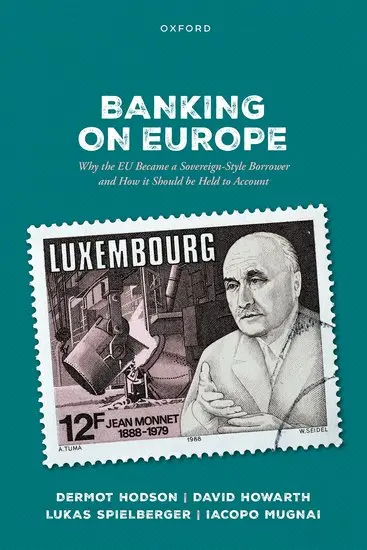
Banking on Europe - Why the EU Became a Sovereign-Style Borrower and How it Should be Held to Account
David HOWARTH, Dermot HODSON, Lukas SPIELBERGER, Iacopo MUGNAI
Availability: Out of stock - available in 10 open days
- Categories: Finance and Economic Theory
- Publisher: OUP - Oxford University Press
- ISBN: 9780198963899
- Binding: Paperback
Summary
The European Union's small, balanced budget is commonly considered to be
one of the most important constraints on the Union's powers. However,
the EU has always borrowed, and it is now borrowing on the scale of a
large state to aid member states' economic recovery from the COVID-19
pandemic and to support Ukraine. This book tells the story of how the EU
became a sovereign-style borrower from Jean-Monnet's 'American Loan' in
1954 to the operation of the Recovery and Resilience Facility seven
decades later.
Drawing on archival analysis and elite
interviews, the book charts the origins and evolution of the European
Commission, the European Investment Bank, the European Bank for
Reconstruction and Development, and the European Stability Mechanism as
European-level borrowers and asks how these bodies' accountability to
parliaments, auditors, citizens, and civil society groups can be
improved. The EU's evolution as a sovereign-style borrower has been
driven by a combination of gradual institutional change and hard
bargaining between member states with high and low borrowing costs, we
find. Since the 1990s, European-level borrowing has also been
increasingly shaped by concerns over the EU's legitimacy crisis.
Borrowing is not simply a technocratic issue, but one that raises
fundamental questions about what sort of polity the EU is and how it
could develop in the future.
Table of contents
1:Introduction: How the EU Came to Issue Debt on the Scale of a Large State
2:Theorizing the EU as a Sovereign-Style Borrower
3:The European Community's First Borrowing Instruments (1954-69)
4:The Rise and Fall of Commission Borrowing: From the First Oil Shock to the Maastricht Treaty
5:The Euro Crisis and New Borrowing Instruments
6:The EIB: How the EU Created the World's Largest Multilateral Lender
7:Borrowing and Third Countries
8:Borrowing Before and After the COVID-19 Pandemic
9:The Commission's Accountability as a Borrower
10:The Accountability of the EIB, EBRD, and ESM
11:Conclusion: The Future of the EU as a Sovereign-Style Borrower